
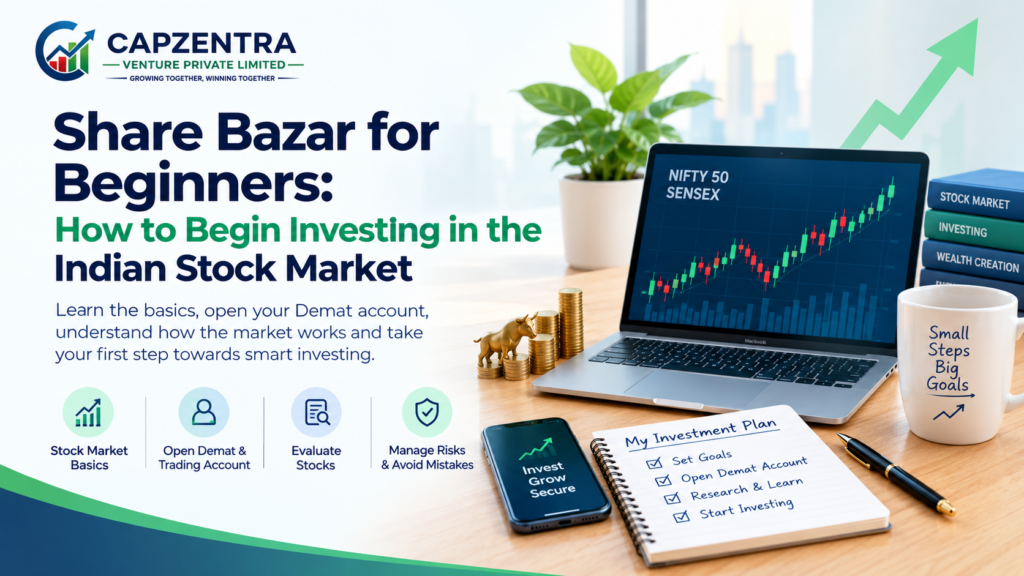
The Indian stock market provides a chance for people to participate in the growth of companies and work toward their long-term financial objectives. But for a beginner investor, words like “shares,” “Sensex,” “Nifty,” “demat accounts,” and “stockbrokers” might sound confusing initially.
Beginners who learn the basics before investing can make better choices, spot risks, and avoid common mistakes. It doesn’t matter if you’re a salaried professional, business owner, or a student learning about personal finance; the first step to responsible investing is to build a solid foundation.
This Share Bazar beginner’s guide will explain the Indian stock market works, how to open an investment account, how to evaluate shares, and what new investors should consider before putting their money in.
What is Share Bazar?
The share bazaar (stock market or share market) is a place where investors buy and sell the shares of companies listed in the public. When you buy a share in a company, you are buying a small part of that business.
Companies can go to the capital markets to raise capital by issuing shares, and investors may benefit from changes in share prices and dividends declared by companies. But neither price appreciation nor dividends are guaranteed, and investors can lose money.
India has two principal stock exchanges:
• National Stock Exchange (NSE): One of the largest stock exchanges in India for securities trading.
• BSE Limited: Another important exchange that provides a platform for trading listed securities.
The Nifty 50 and BSE Sensex are two of the most widely followed indices in the market. These indices track selected groups of companies and are often used as a measure of general market movements.
For anyone researching share market beginner resources, knowing these basic terms helps you to follow financial news and understand how market prices change.
Have a Question? Let’s Connect
Need guidance on stock market investments, mutual funds, SIPs, or portfolio management? Connect with the Capzentra team to discuss your financial goals and explore suitable investment solutions.
How does the Indian stock market function?
The stock market is a regulated marketplace that matches buyers and sellers. Investors usually place orders through a trading platform provided by a stock broker.
Share prices fluctuate based on the company’s performance, supply and demand, economic conditions, interest rates, industry developments, and investor expectations.
For example, if a company is expected to boost its earnings, demand for its stock might go up. However, if the company produces disappointing results or is having business problems, the share price may fall.
The market also has two important segments:
Primary market: Companies issuing securities to investors, often through an initial public offering (IPO).
Secondary market: Investors trade securities that are already listed on a stock exchange.
Understanding these differences can help beginners to understand how shares get onto the market and how day-to-day trading works.
How to Start Investing in the Share Bazar
All you need to start is a few essentials. Beginners should be careful with these steps and not rush to buy shares.
1. Define your financial objectives.
Investing without knowing what you want to achieve. Your goals may be to save for a future expense, build long-term wealth, or prepare for retirement.
Also consider when you want the money. Money that you need for current expenses is not a good candidate for direct equity investment, because stock markets can fluctuate so much in the short term.
Keep your emergency savings separate and don’t invest money you need for basic household expenses.
2. Open a Demat and Trading Account
To buy and hold listed shares in India, investors typically require a demat account and a trading account.
• Demat account: For holding securities in electronic form.
• Trading account: This enables you to execute buy and sell orders through a broker.
• Bank Account: Provides a means for the payment and receipt of funds for transactions.
Select a broker registered with the Securities and Exchange Board of India (SEBI) and check the registration details before opening an account.
You will typically have to undergo KYC verification and provide mandatory identity, PAN, address, and banking details. Requirements may vary depending on your situation and the intermediary.
For more information, see the SEBI investor guide to securities trading.
3. Be aware of the fees.
Before picking your broker, check out their fee structure. Costs may include brokerage, applicable taxes and statutory levies, transaction charges, and account maintenance fees.
Some platforms may advertise low brokerage, but the overall cost of investing may include other charges. Read the schedule of charges carefully and keep copies of your transaction statements.
4. Learn Before You Purchase Your First Share
A newbie should understand basic financial concepts before selecting a company. Start with revenue, profit, debt, earnings per share, price-to-earnings ratio, and market capitalization.
You need to understand the difference between trading and investing. The standard approach to investing is based on the long-term business prospects of a company. The standard approach to trading is based on shorter-term buying and selling.
If you are a person studying share bazaar beginner strategies, then it is more useful to learn the fundamentals first rather than depending on tips given by social media or trying to predict the daily price movements.
Selecting Shares for Investment
When you buy a stock, you are buying a slice of a company, not just its price at the moment.
Financial performance of the company analysis
Examine the company’s revenues, profits, cash flow, debt levels, and financial statements over a number of years. Good business performance in the past is not a guarantee of continued success in the future, but it can provide useful context.
Get the Business Model
Understand how the company makes money, who the customers are, who the competitors are, and whether it has a sustainable market for its products or services.
A beginner may find it easier to get started with a business that is simple to understand than one where the operations and financial risks are difficult to assess.
Valuation Review
A well-known company is not a good investment at every price. Compare valuation measures to the company’s growth prospects, profitability, industry conditions, and risks.
Just because a stock is cheap does not mean it’s cheap.
Spread your investments.
Don’t put all your money in one company or industry. Diversification helps to spread the exposure across the investments but cannot remove the market risk.
Beginners who don’t have the time or experience to research individual companies can also learn about diversified equity mutual funds and index funds before deciding on the approach that works for them.
Common Mistakes To Avoid in Share Bazaar
The beginner who comes to the market without a plan often makes mistakes that can be avoided.
Don’t buy shares because a friend, influencer, or online group is predicting a price rise—without verification.
Looking for fast profits: Stock market investing is no guarantee of making money fast. Short-term prices can be volatile.
Borrowing to invest: Taking out loans or using credit cards to purchase shares can add to financial pressure and the risk of losses.
Putting all your eggs in one basket: If you have all your investments in one company, it can introduce a lot of company-specific risk in your portfolio.
Panic buying and selling: Emotional decisions when markets rally or decline can wreck a sound investment plan.
Ignoring charges and taxes: Transaction costs and applicable taxes affect your final returns.
SEBI recommends dealing with registered intermediaries, understanding investment risks, and avoiding unregistered operators and guaranteed return claims. Review its investor do’s and don’ts when you invest.
Building a Disciplined Investment Plan
Good investment processes start with realistic expectations and a plan that’s appropriate for your financial situation.
First, you need to clarify your goals and decide how much you can invest without affecting your necessary expenses. Review your investments on a periodic basis and keep records of transactions. Learn how to read company financial statements.
You don’t need to trade every day to be an investor. Buying and selling often can drive up costs and lead to emotional decisions. Some objectives may be long-term but still need to be reviewed regularly with the knowledge that losses can be experienced in the market.
In case you want personalized advice on investments, you may approach a SEBI-registered investment adviser. Check that the adviser is registered and the type and price of the services to be provided.
Visit Capzentra for more financial education and other resources. Utilize educational material to gain knowledge about any investment and form your own judgment before making a decision.
Summary
Learning about the share bazaar is a continuous process, which requires patience, research, and disciplined financial planning. Beginners can start by understanding how stock exchanges work, opening accounts through registered intermediaries, learning how to evaluate companies, and recognizing the risks involved.
This share bazaar beginner’s guide also highlights an important principle: investment should be based on your financial objectives and risk appetite, not on rumors or assurances of assured returns.
Begin with the basics, keep on learning, diversify wisely, and remember that stock market investments can fall in value. A knowledgeable and realistic approach can help you make more responsible decisions as you grow your investment knowledge.
Frequently Asked Questions About the Indian Stock Market
1. What Is the Share Market for Beginners?
The share market is a marketplace where investors buy and sell shares of listed companies. Beginners should understand how shares and stock exchanges work, learn about market risks, and become familiar with opening a demat and trading account before investing. Learning the basics can help you make more informed investment decisions.
2. How Much Money Should I Invest to Start Investing in the Indian Stock Market?
There is no single investment amount that suits every beginner. The amount you need depends on the share price, the number of shares you purchase, and applicable brokerage and transaction charges. Start with an amount you can afford after covering essential expenses and building emergency savings. Avoid investing money you may need in the short term.
3. Do You Need a Demat Account to Buy Shares in India?
Yes, a demat account is generally required to hold listed shares in electronic form, while a trading account is generally used to place buy and sell orders through a broker. Investors should check the applicable account-opening requirements, fees, and documentation with their chosen SEBI-registered intermediary.
4. Which Are the Best Stocks for Beginners?
There is no single best stock for every beginner. Before investing, research a company’s financial performance, business model, valuation, competitive position, and potential risks. Avoid buying shares solely because of market tips, popularity, or recent price increases. Choose investments based on your financial goals, risk tolerance, and research.
5. How Risky Is the Indian Stock Market?
The Indian stock market involves risk because share prices can fluctuate due to company performance, economic conditions, interest rates, and investor sentiment. You may lose some or all of the money you invest. Understand your risk tolerance, consider diversification, and avoid investing money needed for immediate expenses. Past performance does not guarantee future returns.
6. Stocks or Mutual Funds: Which Is Better for Beginners?
The right option depends on your financial goals, investment knowledge, risk tolerance, and the time you can spend researching investments. Direct stock investing requires you to evaluate individual companies, while mutual funds pool money from investors to invest in a portfolio of assets according to the fund’s objective. Both carry market risk, and neither guarantees positive returns.